Search
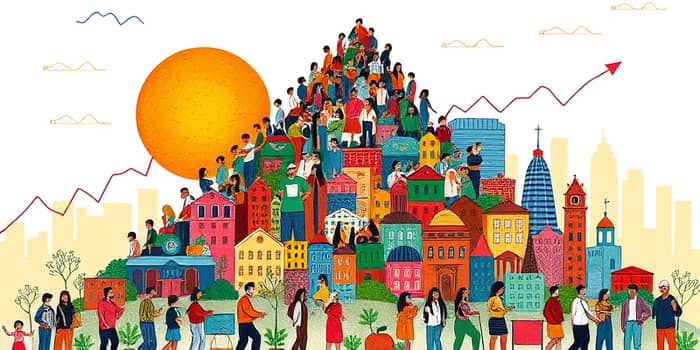
Imagine a nation where the winds of change blow not from politics or resources, but from the very heartbeat of its people.
The demographic dividend represents a transformative window of opportunity that can catapult economies into prosperity.
It arises when a country's age structure shifts, with the working-age population growing faster than dependents.
This phenomenon, often lasting 20 to 30 years, is not a guaranteed fate but a chance to rewrite economic destinies.
From the bustling factories of East Asia to the emerging markets of Africa, history shows that harnessing this dividend can lead to unprecedented growth.
Yet, without strategic action, this fleeting opportunity can slip away, leaving nations grappling with the burdens of an aging population.
This article delves into the mechanics, impacts, and practical steps to leverage demographic shifts for a brighter future.
At its core, the demographic dividend is about more than just numbers.
It is the economic acceleration fueled by a favorable age structure shift during demographic transition.
When fertility and mortality rates decline, there is a temporary surge in the working-age group, typically aged 15 to 64.
This creates a bulge of productive individuals who can drive innovation, savings, and consumption.
However, this dividend does not materialize automatically.
It requires concerted policy investments in areas like health, education, and job creation to unlock its full potential.
Countries that have successfully capitalized on this, such as those in East Asia, have seen their economies soar.
Others, like some in Latin America, missed the chance due to inadequate planning.
The lesson is clear: proactive engagement is key to turning population shifts into prosperity.
The demographic dividend operates through several interconnected channels that boost economic vitality.
These mechanisms transform a youthful population into a powerful engine for development.
Each of these benefits builds on the other, creating a virtuous cycle of growth.
For instance, improved educational outcomes often coincide with age structure maturity, further amplifying the dividend.
Beyond economics, this shift can spur advancements in governance, health systems, and social stability.
Understanding these mechanisms is the first step toward crafting effective policies that maximize the dividend's impact.
The numbers behind the demographic dividend are staggering and offer a glimpse into its transformative power.
Globally, it adds an average of 0.40 percentage points to annual GDP per capita growth during the dividend period.
Some countries experience up to 7.9% higher GDP per capita compared to scenarios with no age structure change.
Historically, from 1960 to 2000, the first demographic dividend contributed 9.2-15.5% of per capita growth in many regions.
Human capital often serves as the main driver, but age structure plays a significant role in amplifying these gains.
To illustrate the varied impacts across regions, consider the following table that highlights key examples.
This data underscores the urgency of acting now to capture these gains.
For upper-middle income countries, the effects are often strongest due to lower youth dependency ratios.
As the world evolves, these projections remind us that the window for action is finite and must be seized with diligence.
History provides a rich tapestry of cases where demographic dividends were either harnessed or wasted.
Learning from these examples can guide current and future strategies.
These stories emphasize that the dividend is not a passive gift but an active pursuit.
They also reveal that catalyzing demographic transition through family planning and health initiatives is crucial for triggering the dividend.
By studying both triumphs and failures, policymakers can avoid past mistakes and build resilient economies.
Countries progress through distinct phases of demographic transition, each requiring tailored policies to maximize benefits.
Understanding these stages helps in planning for long-term sustainability.
This framework, developed by experts like Bloom et al., shows that mortality lags behind fertility decline, initially causing a population surge before the worker bulge emerges.
Navigating these stages requires foresight and adaptability.
For instance, during the early-dividend phase, strategic job creation is essential to absorb the growing labor force.
In the late-dividend phase, emphasis should shift to innovation and retirement planning to sustain growth.
By mapping out this roadmap, nations can align their policies with demographic realities for optimal outcomes.
To capitalize on the demographic dividend, governments and communities must implement a suite of targeted policies.
These actions transform potential into tangible progress.
These policies are interconnected; for example, technological progress can boost educational returns and lower fertility, enabling the dividend.
Risks of missing this opportunity include demographic drag, where aging populations without preparation lead to economic stagnation, as seen in some advanced economies.
By adopting a holistic approach, countries can not only achieve economic growth but also foster social well-being and resilience.
While the demographic dividend offers immense promise, it comes with challenges that require careful management.
The future outlook is shaped by global trends and local actions.
One key challenge is that the dividend is not an automatic guarantee; it hinges on effective policies and human capital development beyond mere age structure.
Emerging views suggest that educational gains may explain much of the so-called "dividend," emphasizing the need for continuous investment in learning.
Globally, lower-income countries, especially in Africa, have youth opportunities before aging sets in, while advanced regions face headwinds from retiring populations.
Beyond economics, demographic shifts can spur innovation, entrepreneurship, and changes in consumption patterns, such as increased demand for leisure, vehicles, and insurance.
To navigate these challenges, nations must stay agile and proactive.
This involves monitoring demographic trends, adapting policies to evolving needs, and fostering international cooperation to share best practices.
By addressing these hurdles head-on, societies can turn potential obstacles into stepping stones for sustainable development.
The demographic dividend is more than an economic theory; it is a call to action for every individual and institution.
By understanding and engaging with population shifts, we can collectively shape a future of prosperity and equity.
Whether you are a policymaker, educator, entrepreneur, or citizen, your contributions matter in harnessing this transformative window of opportunity.
Start by advocating for investments in health and education, supporting job creation initiatives, and planning for aging communities.
Remember, the clock is ticking, and the choices we make today will echo for generations.
Embrace the demographic dividend not as a distant concept, but as a tangible path to building resilient, thriving societies where every age group contributes to shared success.
References