Search
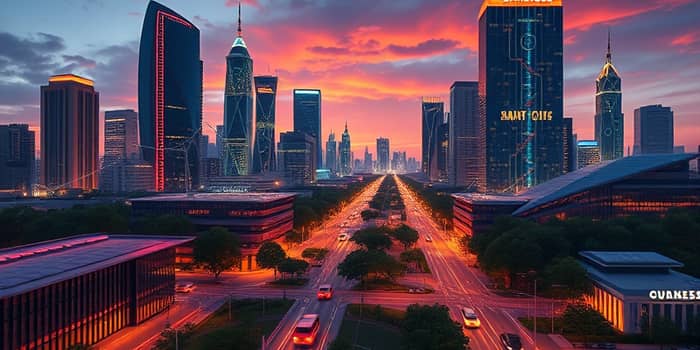
In today's rapidly urbanizing world, the concept of smart cities is no longer a futuristic dream but a tangible reality driving economic growth and investment. transforming urban landscapes globally.
This shift is powered by a convergence of technologies that promise to make cities more efficient, sustainable, and resilient. opening up new avenues for capital.
Understanding the dynamics of this market is crucial for anyone looking to invest in the future of urban living. essential for strategic investment decisions.
The global smart city market is projected to experience staggering growth in the coming years.
Estimates vary, but they consistently point to a multi-trillion dollar opportunity by 2026 and beyond.
For instance, some sources predict the market to reach $3.5 billion by 2026, while others forecast it to grow from $40.1 billion in 2017 to $97.9 billion by 2026.
More recent projections indicate even larger figures, with the market expected to hit $699.7 billion in 2025 and soar to $1,445.6 billion by 2030 at a compound annual growth rate (CAGR) of 15.6%.
This growth is driven by subsectors like urban mobility, which is set to expand from $167.04 billion in 2025 to $250.56 billion by 2030.
Overall, over $3 trillion is anticipated to be spent on modernizing cities with intelligent solutions by 2026.
This table highlights the scale of investment, underscoring the immense potential for returns.
The backbone of smart cities lies in advanced technologies that integrate seamlessly into urban infrastructure.
From connectivity to artificial intelligence, these innovations are transforming how cities operate.
These technologies enhance livability and economic viability in profound ways.
For investors, smart cities offer a diverse range of opportunities across various sectors.
Private capital is surging into infrastructure as an asset class, with co-investment funds playing key roles.
Additionally, stocks in companies focused on GovTech are poised for growth.
Smart city development is not uniform across the globe; regional variations offer unique investment angles.
The Asia-Pacific region leads in market share and growth, driven by rapid urbanization.
North America and Europe follow, with significant investments in modernizing aging infrastructure.
Emerging markets are seeing a push for transport, water, and healthcare solutions.
These initiatives highlight a global commitment to smarter urban environments.
Despite the opportunities, investing in smart cities comes with challenges that need careful navigation.
Rising costs, labor shortages, and regulatory hurdles can impede progress significantly.
To mitigate these, focus on projects with strong public-private partnerships.
For those looking to dive into this market, a strategic approach is essential.
Start by educating yourself on the latest trends and technologies shaping urban development.
By following these steps, investors can achieve financial gains and contribute to better cities.
Smart cities represent a convergence of innovation and investment redefining urban life.
With massive growth projections and diverse opportunities, this market is compelling.
As we move towards 2026 and beyond, the synergy between technology and infrastructure will deepen.
Now is the time to act, investing in the intelligent systems that will power our cities for decades.
References